Water Vapor Basics
What Is a Water Vapor Fireplace? How Mist Flames Work
A water vapor fireplace creates the appearance of a three-dimensional flame using fine water mist and light. The decorative effect does not burn ethanol, wood or gas. It still needs electricity, the water specified for the model, airflow and maintenance. It is a visual fireplace system, not automatically a room heater or a substitute for a humidifier.
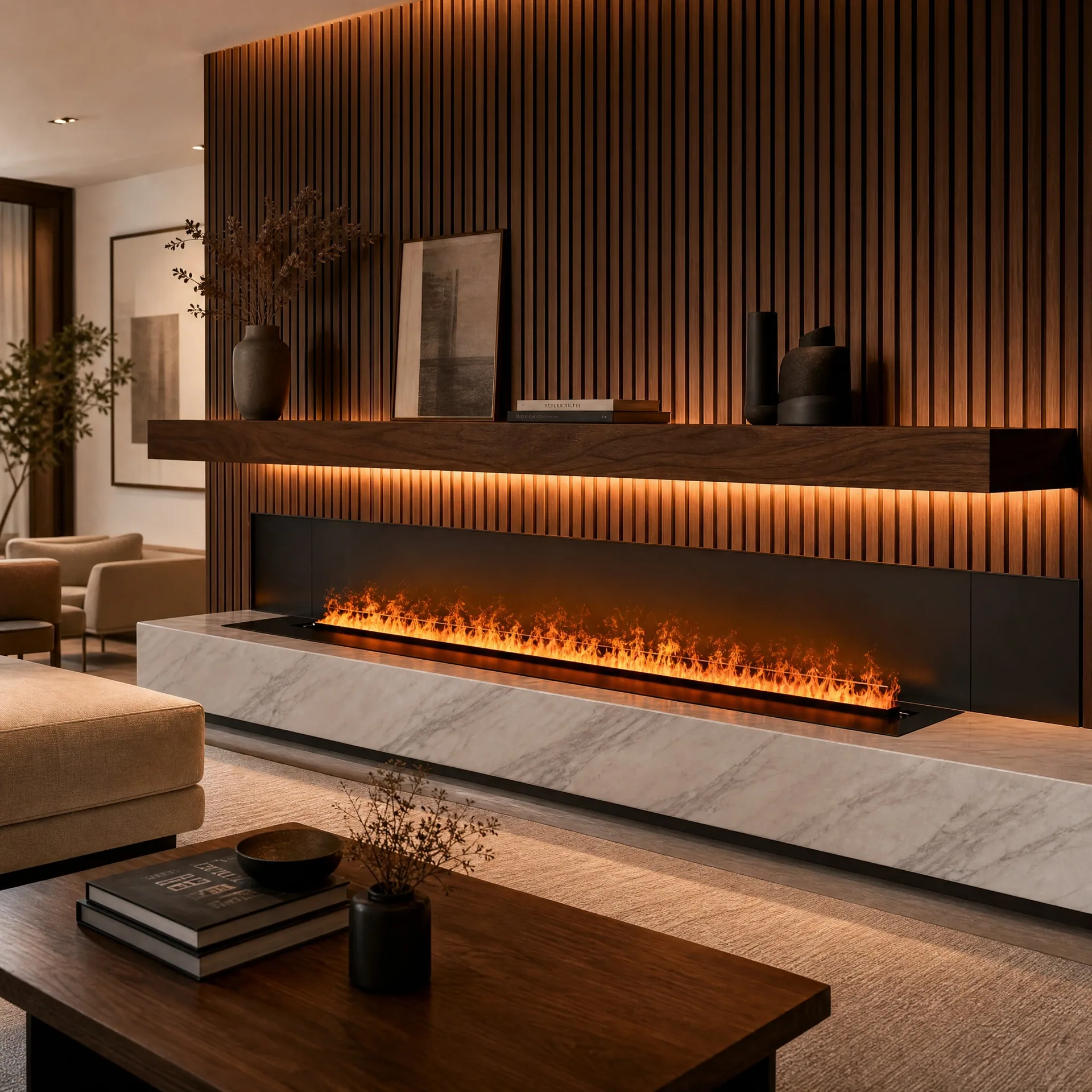
How does the flame effect work?
In an ultrasonic mist system, a transducer helps form fine water droplets from the water supplied to the appliance. The appliance directs that mist through an outlet while LEDs illuminate it. The moving, illuminated droplets create depth and a flame-like pattern. The result depends on the model, light arrangement, airflow and viewing conditions; it is not actual combustion or hot steam produced by boiling a kettle.
“Water vapor fireplace,” “water vapour fireplace” and “mist fireplace” are common search terms for these decorative systems. Technical descriptions often say water vapor even though the visible effect is fine mist. Read the actual product specification rather than assuming every fireplace using the word vapor employs water.
In particular, SEV ethanol vapor uses ethanol and a real combustion flame. It is a different technology. A gas flame, an electric optical effect and illuminated water mist also have different supply and installation requirements.
The main components and their jobs
| Component | Function | What to check |
|---|---|---|
| Water tank or supply system | Provides water to the mist section | Approved water, filling, level control and drainage arrangement |
| Transducer / atomizer | Produces the fine mist | Model-specific cleaning and replacement information |
| LED and airflow system | Lights and shapes the visible effect | Outlet clearance, controls and available settings |
| Power supply and controller | Runs the operating components | Voltage, rated input and accessible electrical connection |
| Enclosure or frame | Coordinates the insert with the room | Service removal, support and compatible surrounding finishes |
Does a water vapor fireplace produce heat?
A mist flame does not burn fuel. Do not interpret the appliance’s electrical input as a rated room-heating output. Some market configurations may include a separate heater, but that function must be stated for the selected model. Confirm heater power and discharge location separately if heat is required. See water vapor fireplaces and heat.
The absence of a combustion flame avoids that particular flame and refueling task, but it does not make the complete appliance risk-free or guarantee that every surface is safe to touch. It contains electrical parts and water. Use the stated installation and operating instructions and maintain appropriate supervision and access.
What does it need: electricity, water and access
Provide the specified electrical supply and a route to fill or supply water. A manual-fill appliance needs an accessible refill point. Automatic water handling needs the connections, water quality and draining arrangement specified for that model. Do not infer that a mains-water line, an unlimited tank runtime or a fixed cleaning interval comes with every version.
Plan access before stone, cabinetry or plaster closes the wall. The insert must be reachable for draining, cleaning, inspection and component service. Avoid blocking the mist outlet or changing the specified airflow to conceal equipment. Installation geometry comes from the selected drawing, not the appearance of a room illustration.
Primary versus Deluxe: a SEFIRE example
| Item | Primary VSFB | Deluxe VSFB |
|---|---|---|
| Listed lengths | 750–2000 mm | 750–2750 mm |
| Water handling | Manual fill and drain | Automatic fill/drain support; confirm supplied arrangement |
| Lighting configuration | Single-row, seven-color | Double-row, 147-color configuration |
| Listed electrical range | 200–760 W across models | 400–1298 W across models |
| Listed water consumption | 0.2–0.8 L/h across models | 0.2–1.1 L/h across models |
These ranges come from the published Primary and Deluxe product information. A range across a family does not mean every model has every capacity or consumption value. Use the nameplate, current manual and delivered configuration for a purchase decision. Read the series comparison for the operating tradeoffs.
Running cost: separate electricity, water and care
Estimate electricity as watts ÷ 1000 × operating hours × local price per kWh. For example, an assumed 500 W input used for four hours at an assumed $0.20/kWh costs $0.40 in electricity. This is arithmetic, not an energy test or current utility rate. Add the specified water, cleaning, service and any separate heater. The running-cost guide provides model-based examples and explicit assumptions.
Water quality, humidity and maintenance
Use the water type required by the manual. Mineral deposits and unsuitable water can affect the mist components, so “any tap water is fine” is not a safe purchasing assumption. Follow the model’s cleaning procedure and do not introduce fragrances, dyes or chemicals that are not expressly permitted. Keep a service record for installations with long opening hours.
Water use can contribute moisture to the room. The effect depends on consumption, room volume, ventilation and other moisture sources. Do not advertise a universal humidity increase or promise that the appliance will replace a humidifier. If condensation appears, stop and have the conditions assessed. The water-quality and humidity guides address these decisions.
Where it fits, and what to decide first
Mist systems can be considered for decorative walls in homes, showrooms and hospitality spaces when a real flame is not required. Evaluate noise in the actual operating mode, sightlines, permitted use hours, water logistics and maintenance access. An indoor model is not suitable outdoors merely because it uses water. Outdoor rating and conditions must be confirmed separately.
For a media wall, read TV installation planning. For a new project, decide the flame length, available opening, viewing sides, expected hours and water arrangement before selecting a model. Use the product range to compare actual specifications.
Frequently asked questions
Is the flame real?
No fuel burns in the mist effect. Water droplets and light create the appearance of flame.
Does it boil water?
An ultrasonic mist design atomizes water; its visible effect should not be confused with boiling steam.
Does it need a chimney?
There is no combustion exhaust from the mist effect, but the appliance still needs its specified enclosure airflow and installation conditions.
Can I leave it running continuously?
Do not assume continuous-duty approval or an unlimited water supply. Confirm operating limits and water arrangements for the exact model.
Discuss your project
Share the opening dimensions, daily use, viewing sides and water-supply options so the product can be selected for the actual project.
Choose a Water Vapor Fireplace