Fireplace Components
What Is a Firebox? Parts, Types, Materials and Maintenance
A firebox is the chamber in a fireplace where fuel burns. In a wood-burning fireplace it contains the fire and is usually lined with firebrick or refractory material. Modern product catalogs also use “firebox” for housings around ethanol burners and electric or water vapor inserts. Those housings have different jobs and cannot be treated as interchangeable combustion chambers.
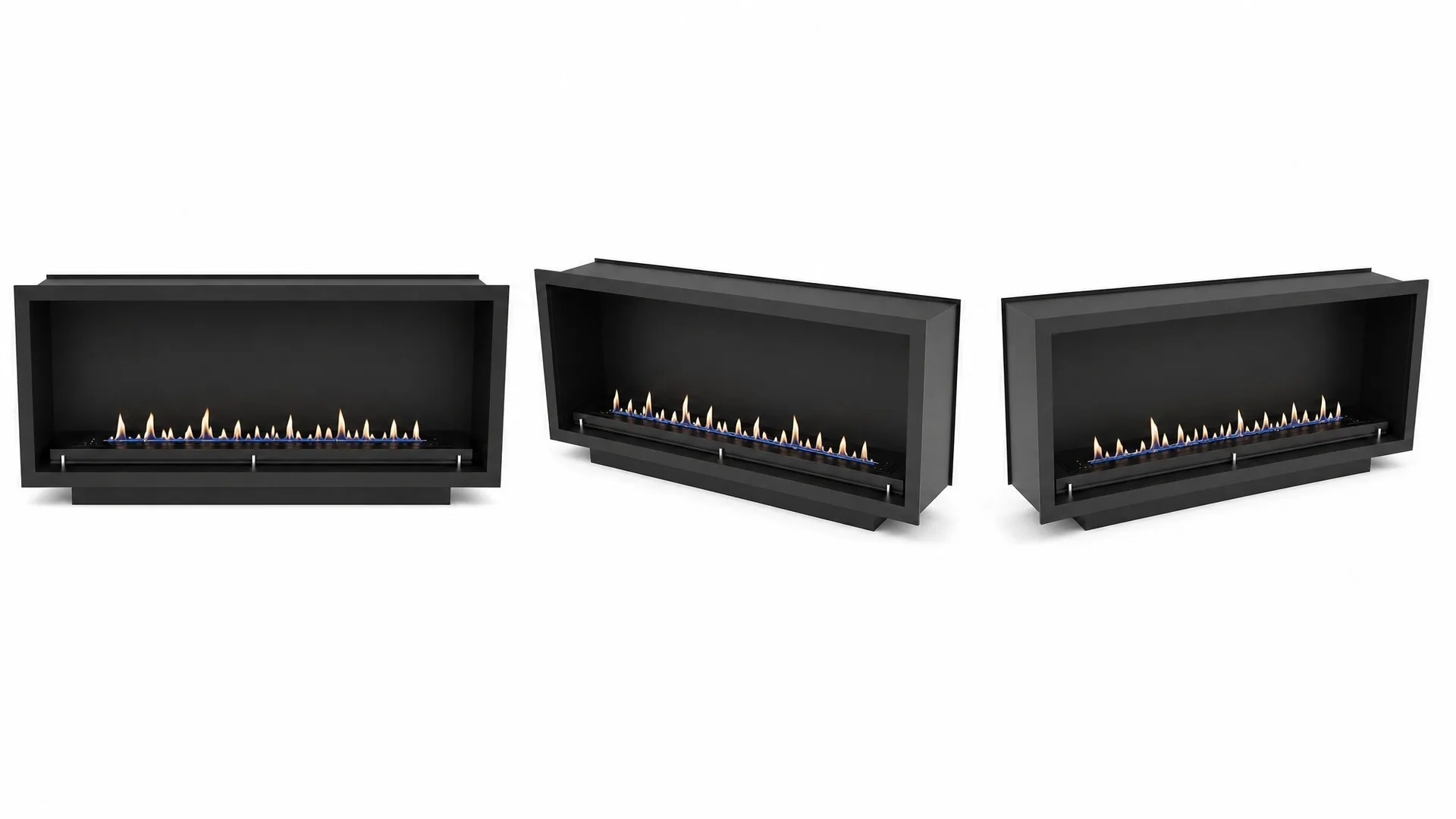
Firebox, fireplace, hearth and insert: the differences
| Term | What it means | What it does not establish |
|---|---|---|
| Firebox | The fire-containing chamber; sometimes a product-specific housing in modern decorative systems | Compatibility with every fuel |
| Fireplace | The complete appliance or installed assembly, including the firebox and its required supporting systems | That every fireplace has a chimney |
| Hearth | The base of a traditional fireplace; a hearth extension protects the floor in front where required | The complete fireplace or a shelf above it |
| Insert | An appliance designed for an approved enclosure or existing fireplace | Permission to place it in any empty opening |
| Surround and mantel | Facing around the opening and the shelf or decorative framework | A substitute for required clearances or a load-bearing support |
In a traditional fireplace, the firebox connects to the smoke path, while a hearth extension lies outside the opening. A direct-vent gas unit has its own designed combustion and venting assembly. An electric or mist insert has no fuel-combustion chamber, even when its surrounding black housing is sold as a firebox. See the separate hearth versus fireplace guide for the floor, chamber and complete-system distinction.
Common firebox types and why the distinction matters
Masonry: the chamber is built into a masonry fireplace, commonly using firebrick and suitable refractory joints. Its condition must be assessed together with the surrounding masonry and chimney. Decorative tile over a damaged chamber is not a structural repair.
Factory-built wood or gas system: the enclosure, refractory panels, burner or grate, and required venting form a specified assembly. Replacement parts and installation dimensions come from that system’s documentation. A generic steel box or panel with a similar appearance is not an equivalent replacement.
Ethanol burner housing: the enclosure must accommodate a real flame, heat, combustion-air requirements, fuel handling and access to the selected controls. A guard or glass screen is model-specific; adding one can change airflow. An electrically controlled burner still produces a combustion flame.
Water vapor or electric housing: coordinate the visual outlet, airflow, electrical components and maintenance access. Mist appliances also need suitable water handling; electric heaters need their specified warm-air path. A housing designed for a mist effect does not thereby become suitable for burning wood or ethanol.
Firebox materials: assess the assembly, not just the finish
Firebrick and refractory panels serve different constructions, while steel can be used in engineered appliance enclosures. Each material has a role in a complete system. A steel panel conducts heat; a stone front does not prove that timber, adhesive or cables behind it remain within their limits. Material thickness, joints, supports, lining and allowable temperatures must be selected for the exact appliance.
For a replacement panel, record the fireplace manufacturer, model and serial number before contacting its service provider. Do not substitute ordinary concrete, wall tile, sheet metal or household filler for a specified firebox component. Product-specific instructions take precedence over generic diagrams or a supplier’s descriptive material name.
Viewing configuration and installation planning
| Layout | Typical design purpose | Coordinate before fabrication |
|---|---|---|
| Single-sided | A front-facing feature wall | Opening, wall depth, flame view and service access |
| See-through / double-sided | Views from opposite sides | Supports, protection and access on both sides |
| Corner or three-sided bay | Views around a projecting feature | Frame geometry, adjacent materials and glass arrangement |
| Tall or custom linear | A project-specific architectural opening | Appliance suitability, transport, support and approved drawings |
Confirm the appliance first, then the enclosure and finished wall. Draw the visible opening, overall frame, rough opening, required air spaces, services and access route separately. Do not equate a product’s overall dimensions with the wall cutout. A recessed or flush finish still needs the clearances and service access stated for the selected configuration.
Maintenance and signs that need assessment
Let a combustion appliance cool and follow its shutdown procedure before inspection. Look for damaged lining, displaced panels, open joints, distortion, corrosion or loose supports. These observations are reasons to obtain model-specific assessment, not a remote diagnosis of safe operation. Stop use and arrange qualified inspection where damage, smoke leakage or overheating is suspected.
For wood systems, include the chimney and smoke path in the inspection plan. For gas or ethanol, have the appropriate service provider assess the appliance and its connections. For mist systems, follow the water-quality and cleaning instructions and keep the enclosure accessible. A clean decorative face does not establish that hidden components are sound.
What to send for a firebox or frame quotation
- Appliance manufacturer, exact model, manual and intended fuel or visual technology.
- Front and section drawings, visible opening, wall construction and viewing sides.
- Required service route, utility connections and finish build-up.
- Photos and model identification for an existing fireplace; destination and installation responsibility for a new project.
Explore SEFIRE firebox formats and the installation planning checklist. These are coordination resources, not authorization to modify an existing wood or gas fireplace.
Frequently asked questions
Is a firebox the same as a fireplace?
No. The firebox is one part; the fireplace is the complete appliance or installed system.
Can a water vapor frame hold an ethanol burner?
Only if the enclosure and selected burner are explicitly designed and approved together. Similar dimensions do not establish compatibility.
Can a damaged firebox simply be painted?
Paint does not repair failed lining, joints or structure. Identify the system and obtain the prescribed repair assessment first.
Does every firebox require the same hearth or chimney?
No. Requirements depend on the appliance type, its installation instructions and applicable local rules.
Discuss your project
Send the appliance model, wall section and viewing configuration so the enclosure can be coordinated with the intended system.
Discuss a Firebox or Frame